$145 a workshop hour 000-000-0000

What we do

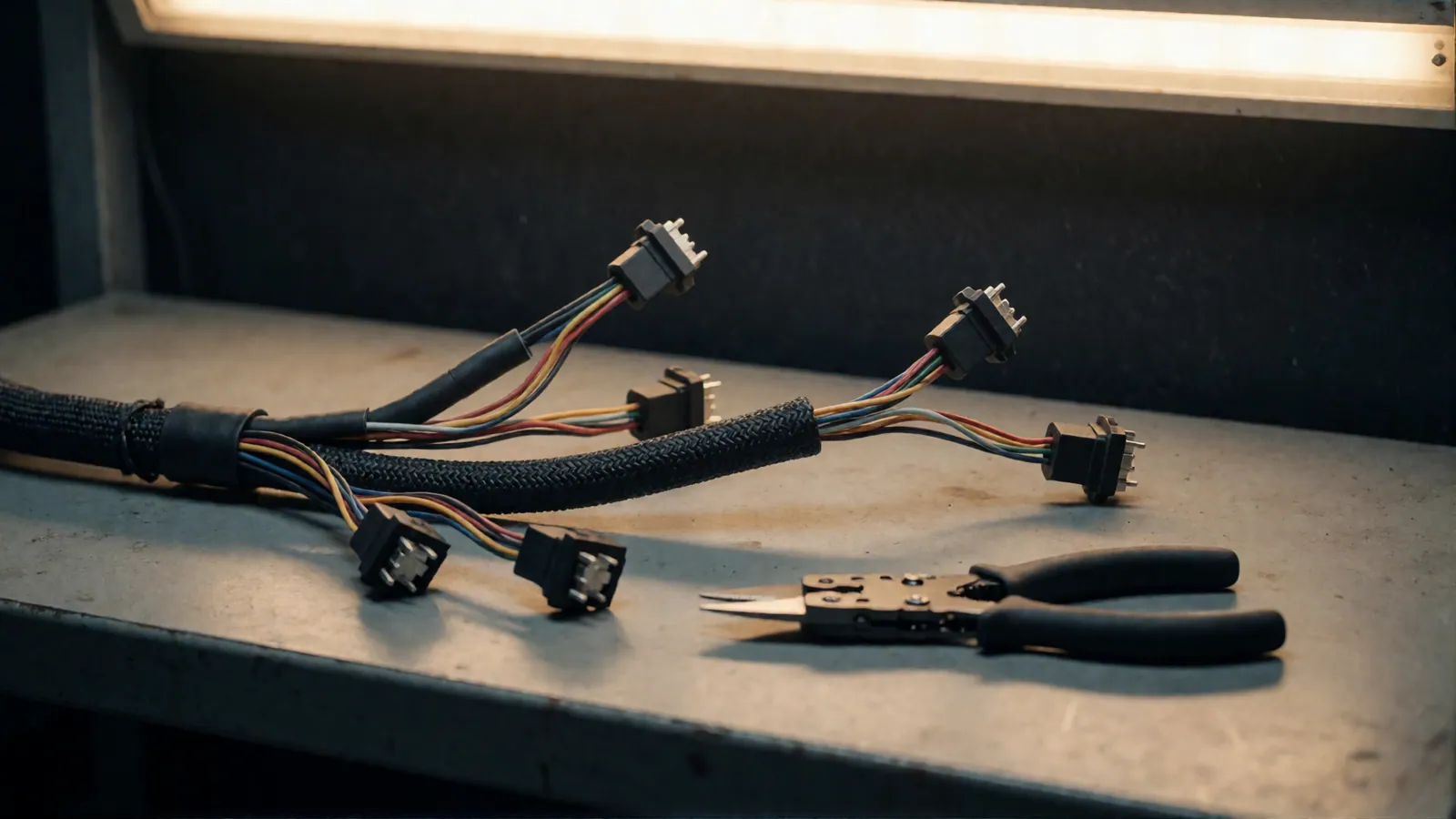
Wiring, looms and connectors

Chafed harnesses, corroded pins, rodent damage and the joins somebody made with a scotch-lock in a hurry three winters ago.

  • four jobs on the rate card
  • Labour from $145
  • one to sixteen hours

“It comes and goes over bumps and nobody can catch it.”

Most intermittent electrical faults are mechanical faults wearing an electrical coat. A conductor breaks inside insulation that still looks perfect. A pin backs half out of its housing. A ground strap goes green underneath where nobody can see it. None of those shows up on a meter reading continuity with nothing flowing, and all of them show up the moment the circuit is asked to carry current.

So harness work here starts with a voltage drop test under load along the suspected run, and with finding out what the harness touches and what moves when the vehicle does. Vibration, heat and water are the three causes and each leaves a different signature: vibration breaks conductors at the point where the loom is clamped, heat opens joints that were only mechanically sound to begin with, and water tracks down inside a sleeve and comes out at the lowest connector, which is often nowhere near where it got in. Repairs are soldered and sealed, or crimped with the right tool for that terminal and heatshrunk, and the loom is re-supported away from whatever it was rubbing on — because a repair that leaves the cause in place is a repair with a date on it. A twisted pair of wires under a scotch-lock is not a join; it is a resistance that grows.

What would actually be measured

In roughly this order, and none of it names a part

  • A voltage drop test under load along the run, which is the only test that finds a broken conductor inside good insulation
  • Every connector on the circuit opened, and the pins inspected for backed-out terminals, spread contacts and green
  • The ground points, which are the single most common thing nobody looks at
  • Where the loom is clamped, what it crosses, and what moves relative to what
  • Previous repairs, which are frequently the fault rather than the history of it
  • On stored machinery, the whole run opened along the length a rodent got into, and counted

The jobs

What you can buy, and what the labour costs

Hours are chargeable hours. The figure is the published rate for where the work happens multiplied by those hours, and there is nothing else in it — parts are separate and are at cost plus 20 per cent with both numbers on the invoice.

Wiring, looms and connectors. Hours are chargeable hours. The figure is the published rate for where the work happens, multiplied by the hours, and there is nothing else in it — parts are separate and are at cost plus 20 per cent with both numbers on the invoice. Where a job can be done in the workshop or on site, its figure is the workshop one. Done where the vehicle stands rather than here, the same hours are at the on-site hour, $185.
JobHoursWhereLabour
Harness and connector repair one to four hours workshop or on site $145 to $580
Rodent damage repair two to eight hours on site $370 to $1,480
Loom section rebuild five to sixteen hours workshop $725 to $2,320
Trailer and towing electrics one to four hours workshop or on site $145 to $580

Harness and connector repair

$145 to $580

A chafed section, a corroded connector, a pin that has backed out, or a previous repair that was made with the wrong thing.

  • one to four hours, turnaround same day
  • workshop hour, $145, here — or the on-site hour, $185, where it stands

The first hour: Finding the damage, which is most of the work. A conductor broken inside intact insulation looks like nothing at all and shows up on a voltage drop test under load.

What you are left holding: The repaired section, sealed, re-supported and photographed before it is wrapped.


Rodent damage repair

$370 to $1,480

Mice and squirrels in stored machinery and parked vans. Rarely one wire, and the count is never known until the loom is opened.

  • two to eight hours, turnaround one to three days
  • on-site hour, $185, on site

The first hour: Opening the loom along the length they got into and counting. The estimate before that hour is a guess and is described as one.

What you are left holding: Every damaged conductor repaired and identified, the nesting material cleared out, and a written list of what was found so an insurer can read it.

Loom section rebuild

$725 to $2,320

When a section has had enough — fire damage, a long run of corrosion, or twenty years of other people's repairs — it is rebuilt rather than patched again.

  • five to sixteen hours, turnaround three to ten days
  • workshop hour, $145, workshop

The first hour: Recording what is there before anything is cut. Half of a rebuild is the map.

What you are left holding: The new section, made to the original routing with correct terminals and sealing, and a drawing of what was made.

Trailer and towing electrics

$145 to $580

Sockets, plugs, the last three feet of cable behind them, and getting the lights on a trailer to work without upsetting the vehicle pulling it.

  • one to four hours, turnaround same day
  • workshop hour, $145, here — or the on-site hour, $185, where it stands

The first hour: Testing the socket under load. A pin that lights a test lamp and collapses under a bulb is the commonest trailer fault there is.

What you are left holding: A working circuit, tested with a load on every pin rather than with a test lamp, and the wiring written down.

How that figure is arrived at

  • Workshop hour× one$145
  • The same rate, at the long end× four$580
  • Parts, if any are neededcost + 20%separate
  • Labour for this jobone to four hours$145 to $580

The workshop hour is $145 and it is on the rates page. That multiplication is the whole of the labour charge: no callout fee on top of it, no shop supplies percentage and no environmental levy. Those are the workshop figures. Done where the vehicle stands rather than here, the same hours are at the on-site hour, $185. It is the cost of the work — it is not a quotation for a vehicle nobody has seen.

Where this stops

What this is not

We do not patch a run that has had enough. If a section is corroded along its length, or has been repaired four times by four people, we will say it needs rebuilding and roughly what that costs, rather than adding a fifth repair to it and taking the money.

Everything we do not do, and who we send you to

A closed workshop roller shutter in flat daylight

A worked example

The combine that stopped three times in one week

Arable farm, about nine hundred acres · One combine, two tractors, harvest under way

The machine cut out at random and restarted after ten minutes. It had been to a dealer twice in the winter, and both visits ended with codes cleared and nothing found. It only ever did it with the header full and the machine working hard.

What we did: Instrumented rather than inspected: a recorder left on the supply and the ground of the circuit the stored codes pointed at, and the machine sent back out. Four hours over two evenings.

The whole example

Every case study on this site is an illustrative composite assembled from several jobs. No customer is named, no vehicle is identifiable, and there is not a single testimonial on this website attributed to a person — a fabricated one would be the one genuinely dishonest thing a workshop's website can do.

Arable farm, about nine hundred acres

Worth reading first

Rodent damage, and why it happens to the machine that stands still

It is not bad luck and it is not random. Nine months in a dry shed is exactly the habitat, and the things worth doing about it between harvest and spring cost almost nothing.

Questions

What does it cost to find out what is wrong?

One hour, charged at the rate for where it happens: $145 in the workshop, $185 on site, $125 on the bench for a control unit. That hour is measurement rather than guessing, and at the end of it you get what was measured and what it would cost to put right, in writing. If the fix takes under fifteen minutes it happens inside the hour and there is nothing more to pay.

Do you come out, or does it have to come to you?

Trucks and machinery are almost always seen where they stand. Cars and vans are usually quicker and cheaper here, because the equipment does not have to be carried to them. Bench work on a control unit only happens at Hatfield Lane.

How far do you travel?

Twenty-five miles from Goshen carries no travel charge. Beyond that the road time is charged at the workshop rate rather than the on-site rate, which is the cheaper of the two honest ways to do it. The service area page lists the towns we reach before nine o'clock.

How do you charge for parts?

At what they cost us plus twenty per cent, and the invoice shows both numbers. We take no rebate, commission or bonus from any supplier for fitting one brand rather than another.

Wiring, looms and connectors · labour from $145

Describe the symptom, or telephone

The symptom check takes about three minutes and gives you a written summary of which circuits would be tested first and why, with the hours and the published rate against each. It is an indicative scope and not a diagnosis — nobody has seen the vehicle — but it is a better opening than a blank contact form. If you would rather skip it, the telephone works.