$145 a workshop hour 000-000-0000

What we do

Agricultural machinery

Tractors, combines, balers and sprayers: monitors, sensors, guidance wiring, and the harness that has spent its life in dust, chaff and vibration.

  • three jobs on the rate card
  • Labour from $265
  • one to six hours

“It stopped in the middle of a field and the weather is turning.”

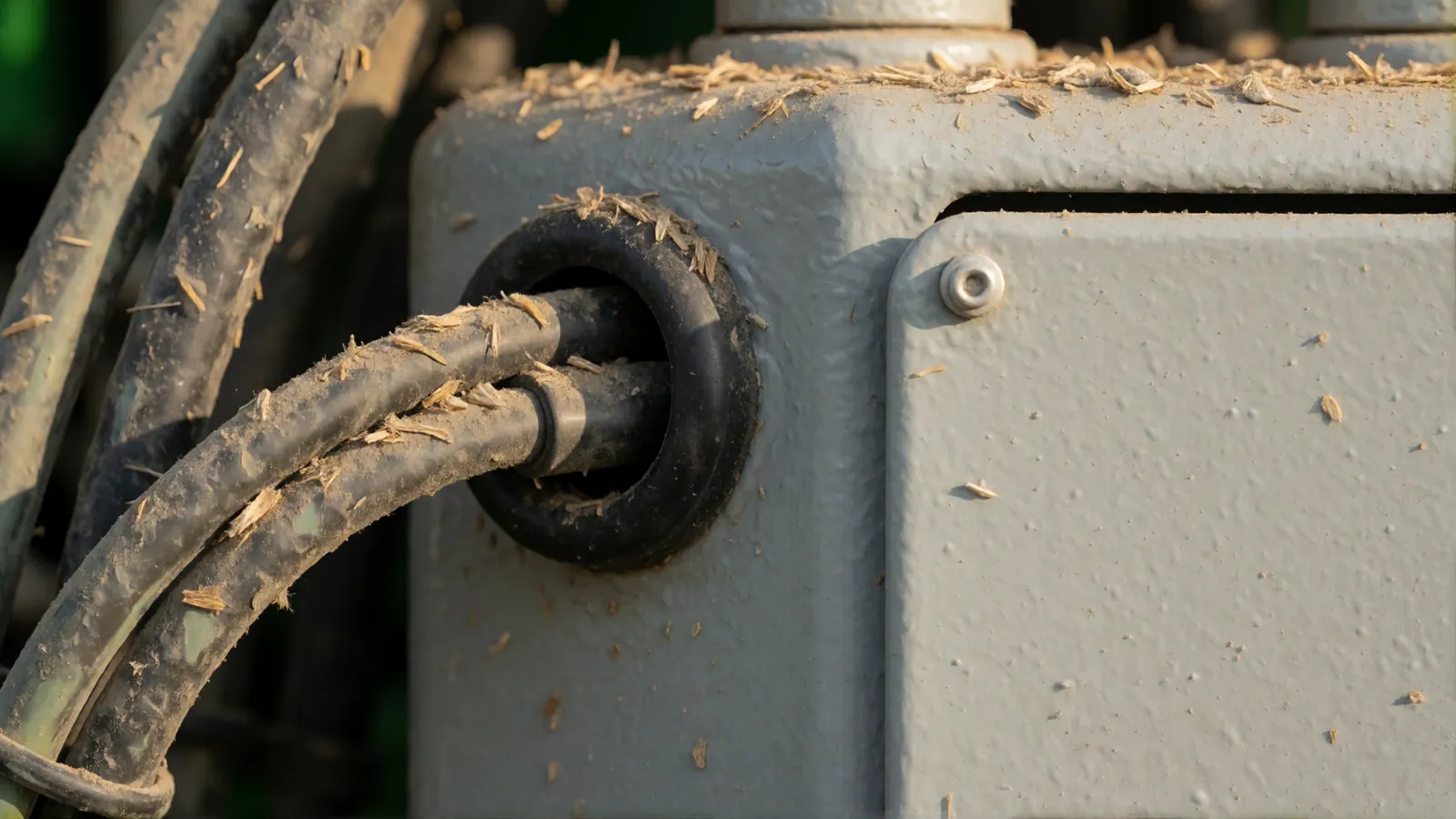
Agricultural electrics fail for three reasons and all three are environmental. Vibration breaks conductors inside insulation that still looks new. Dust and chaff hold moisture against connectors until the pins go green. And a machine that stands for nine months in a dry shed is, to a mouse, a heated building full of bedding material.

All three of those are predictable, which is the entire argument for looking at a machine in February rather than in August. The season does not care: a combine standing in a cut field with rain coming is a different kind of problem from a van that will not start, and the arithmetic on a lost day at harvest makes almost any electrical work cheap by comparison. So this splits into two halves that are really one offer. In the quiet months, a check: batteries, terminals, charging output under load, ground straps, the chafe points that always chafe on that model, connector seals, and the lighting nobody has switched on since October. In the season, a callout — evenings and weekends, at the published after-hours rate — where the job is to get it moving if that is possible and to say so honestly within the first hour if it is not, because a machine that has to be recovered is better recovered before dark.

What would actually be measured

In roughly this order, and none of it names a part

  • Batteries and charging under load, because that is what actually strands a machine
  • Ground straps and every chassis earth, cleaned back to bright metal and protected
  • The harness runs that vibration has been working on since the last season, at the clamps
  • Connector seals and boots, which is where dust plus one wet morning becomes a fault in July
  • Rodent damage along the whole run rather than at the one wire that showed a symptom
  • Monitors, sensors and guidance wiring, including whether the monitor is unfed or simply not being told anything

The jobs

What you can buy, and what the labour costs

Hours are chargeable hours. The figure is the published rate for where the work happens multiplied by those hours, and there is nothing else in it — parts are separate and are at cost plus 20 per cent with both numbers on the invoice.

Agricultural machinery. Hours are chargeable hours. The figure is the published rate for where the work happens, multiplied by the hours, and there is nothing else in it — parts are separate and are at cost plus 20 per cent with both numbers on the invoice. Where a job can be done in the workshop or on site, its figure is the workshop one. Done where the vehicle stands rather than here, the same hours are at the on-site hour, $185.
JobHoursWhereLabour
Harvest-season breakdown callout one to six hours on site $265 to $1,590
Pre-season electrical check two to three hours on site $370 to $555
Monitor, sensor and guidance wiring two to six hours workshop or on site $290 to $870

Harvest-season breakdown callout

$265 to $1,590

Evenings and weekends between the middle of July and the end of October, for machinery that is standing in a field. Charged at the after-hours rate, which is published like every other rate.

  • one to six hours, turnaround same day where we can reach it
  • after-hours on-site hour, $265, on site

The first hour: Getting it moving if that is possible, and being honest within the first hour if it is not, because a machine that has to be recovered is better recovered before dark.

What you are left holding: Either the machine running, or a written note of what it needs and what we did to get it as far as the yard.


Pre-season electrical check

$370 to $555

The smartest thing on this price list. Batteries, terminals, charging output under load, ground straps, the chafe points that always chafe, connector seals, and the lighting — in February, when a fault is an inconvenience rather than a lost day.

  • two to three hours, turnaround booked in the quiet months
  • on-site hour, $185, on site

The first hour: The batteries and the charging system, because that is what strands a machine, and the harness runs that vibration has been working on since the last harvest.

What you are left holding: A written condition report per machine with photographs, a list of what was put right on the day, and a list of what should be ordered before the season.

Monitor, sensor and guidance wiring

$290 to $870

Cab monitors, implement sensors, guidance and steering wiring, and the ISOBUS connections between a tractor and whatever is on the back of it.

  • two to six hours, turnaround one to three days
  • workshop hour, $145, here — or the on-site hour, $185, where it stands

The first hour: Establishing whether the monitor is not being told anything or is not being powered properly, which are two completely different jobs and look the same from the seat.

What you are left holding: The circuit traced and repaired or the wiring installed, with a drawing of what runs where.

How that figure is arrived at

  • After-hours on-site hour× one$265
  • The same rate, at the long end× six$1,590
  • Parts, if any are neededcost + 20%separate
  • Labour for this jobone to six hours$265 to $1,590

The after-hours on-site hour is $265 and it is on the rates page. That multiplication is the whole of the labour charge: no callout fee on top of it, no shop supplies percentage and no environmental levy. It is the cost of the work — it is not a quotation for a vehicle nobody has seen.

Where this stops

What this is not

We do not work on the machine's mechanical or hydraulic systems, and we do not do warranty work on behalf of any manufacturer. Where a sensor is reading correctly and reporting something mechanical, that is a real finding and it goes to your dealer in writing.

Everything we do not do, and who we send you to

A closed workshop roller shutter in flat daylight

A worked example

The combine that stopped three times in one week

Arable farm, about nine hundred acres · One combine, two tractors, harvest under way

The machine cut out at random and restarted after ten minutes. It had been to a dealer twice in the winter, and both visits ended with codes cleared and nothing found. It only ever did it with the header full and the machine working hard.

What we did: Instrumented rather than inspected: a recorder left on the supply and the ground of the circuit the stored codes pointed at, and the machine sent back out. Four hours over two evenings.

The whole example

Every case study on this site is an illustrative composite assembled from several jobs. No customer is named, no vehicle is identifiable, and there is not a single testimonial on this website attributed to a person — a fabricated one would be the one genuinely dishonest thing a workshop's website can do.

Arable farm, about nine hundred acres

Worth reading first

Rodent damage, and why it happens to the machine that stands still

It is not bad luck and it is not random. Nine months in a dry shed is exactly the habitat, and the things worth doing about it between harvest and spring cost almost nothing.

Questions

What does it cost to find out what is wrong?

One hour, charged at the rate for where it happens: $145 in the workshop, $185 on site, $125 on the bench for a control unit. That hour is measurement rather than guessing, and at the end of it you get what was measured and what it would cost to put right, in writing. If the fix takes under fifteen minutes it happens inside the hour and there is nothing more to pay.

Do you come out, or does it have to come to you?

Trucks and machinery are almost always seen where they stand. Cars and vans are usually quicker and cheaper here, because the equipment does not have to be carried to them. Bench work on a control unit only happens at Hatfield Lane.

How far do you travel?

Twenty-five miles from Goshen carries no travel charge. Beyond that the road time is charged at the workshop rate rather than the on-site rate, which is the cheaper of the two honest ways to do it. The service area page lists the towns we reach before nine o'clock.

What happens in harvest?

From mid-July to the end of October one of us is on call in the evenings and at weekends for machinery standing in a field, at the published after-hours rate. It is a real arrangement rather than a promise to answer any telephone at any hour, which a workshop of five people cannot honestly make.

Agricultural machinery · labour from $265

Describe the symptom, or telephone

The symptom check takes about three minutes and gives you a written summary of which circuits would be tested first and why, with the hours and the published rate against each. It is an indicative scope and not a diagnosis — nobody has seen the vehicle — but it is a better opening than a blank contact form. If you would rather skip it, the telephone works.