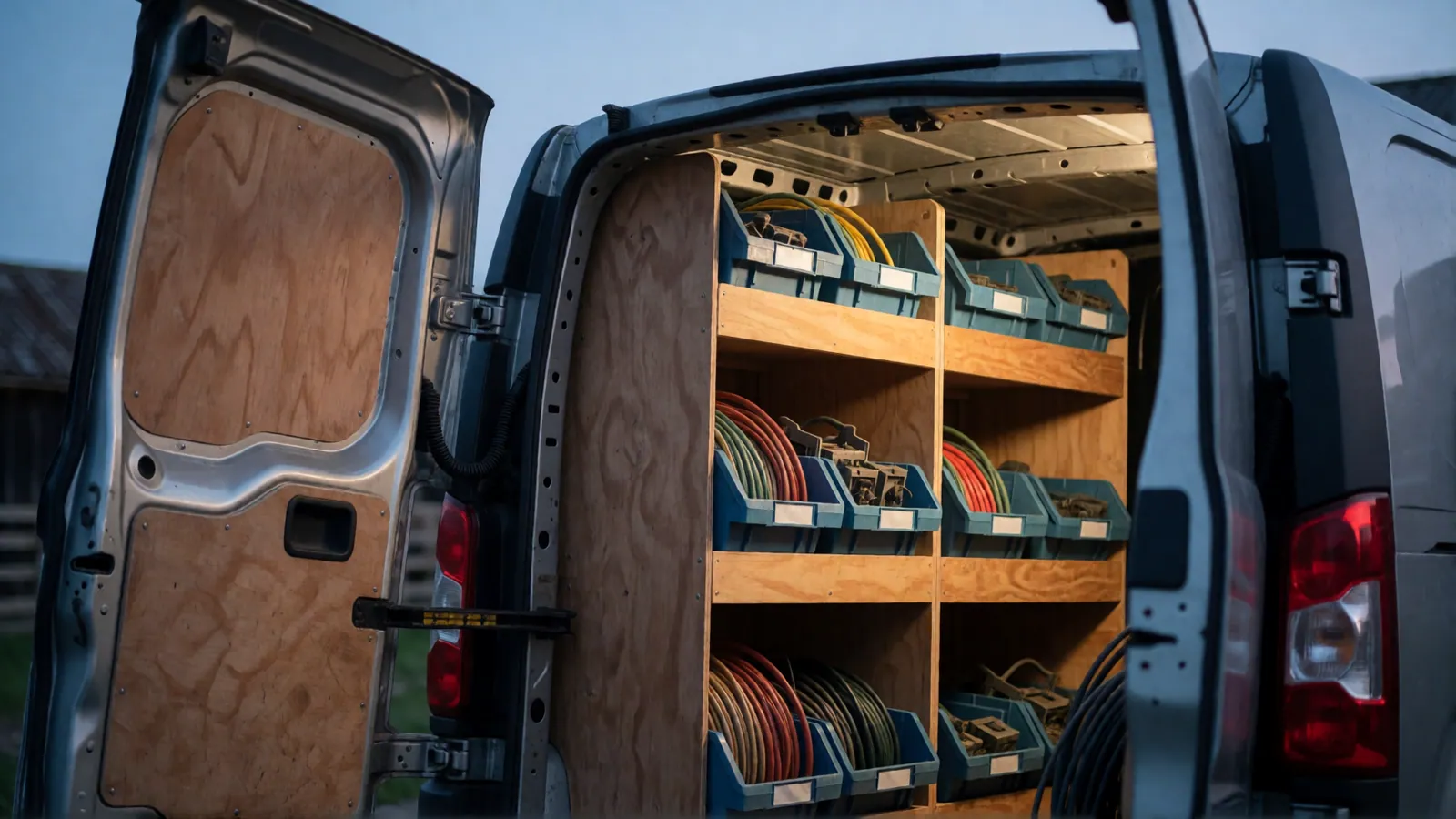
Trucks and machinery are seen where they stand; that is most of the work. Cars and vans are usually quicker and cheaper in the workshop, because the equipment does not have to be carried to them. Bench work on a control unit only happens at Hatfield Lane.
$145 an hour here
$185 an hour where it stands
Free travel inside twenty-five miles
A mobile auto electrician who says everything can be done at the roadside is either carrying a
workshop in a van or is not doing some of the work. Both vans here carry a scope, a bench power
supply, a hydraulic press for terminals, a full set of connector bodies and enough cable to
rebuild a loom section in a field. What they do not carry is a microscope, an extraction arm
and a hot-air station, because those things do not work on gravel in the wind.
So the split is real and it is worth explaining rather than hiding, because it is also the
cheapest advice on this website: for a car or a van, bringing it here is usually both faster
and less expensive.
Machinery is seen where it stands. Trucks and machinery are seen where they stand, because a machine in a field cannot come to a workshop and a truck standing still is losing money by the hour. Cars and vans are usually quicker and cheaper here. Bench work on a control unit only happens at Hatfield Lane.
Where it stands
Trucks, trailers, tractors, combines, balers, sprayers, plant and anything that would need
a low-loader to move. Also anything that will not start and is somewhere a tow would cost
more than the job.
$185 an hour, minimum one hour
Travel free inside twenty-five miles
Here at Hatfield Lane
Cars, vans and pickups, and anything that needs the vehicle left for a drain test or a
fault to be provoked over several days. The bay is deep enough for a tractor unit and there
is a pit at the back of it.
$145 an hour
No minimum beyond the diagnostic hour
On the bench
Control units only, and always here. A module can be posted or dropped in on its own —
quite a few of them arrive from workshops rather than from owners, which is a normal thing
in this corner of the trade.
$125 an hour, the cheapest of the four
Assessment is one hour and comes off the repair
By job
What is only ever done in one of the three places
Always where it stands
Rodent damage repair — two to eight hours, $370 to $1,480
24-volt starting and charging diagnosis — one to three hours, $185 to $555
Trailer wiring and ABS fault tracing — one to four hours, $185 to $740
Body, PTO and auxiliary control faults — two to six hours, $370 to $1,110
Harvest-season breakdown callout — one to six hours, $265 to $1,590
Pre-season electrical check — two to three hours, $370 to $555
Always on the bench
Bench assessment of a control unit — one hour, $125
Component-level board repair — two to six hours, $250 to $750
Module connector and pin repair — one to three hours, $125 to $375
Everything else on the rate card is either in the workshop or can go either way, and the
telephone call decides which. A job that can go either way is listed at the workshop hour.
Done where the vehicle stands rather than here, the same hours are at the on-site hour, $185.
The harvest arrangement, stated exactly
From the middle of July to the end of October one of us is on call in the evenings and at weekends for machinery that is standing in a field. That is a harvest arrangement and it is charged at the after-hours rate, which is published like everything else.
What that is not is a twenty-four-hour emergency service. Five people cannot honestly promise
to answer any telephone at any hour of any day, and a workshop that advertises one is either
much larger than this or is going to disappoint somebody in October. Naming the months, the
hours and the rate is the version of that promise which can actually be kept.
$145 a workshop hour · $185 on site · agreed before it starts
Telephone, and we will say which of the three it is
The symptom check takes about three minutes and gives you a written summary of which circuits would be tested first and why, with the hours and the published rate against each. It is an indicative scope and not a diagnosis — nobody has seen the vehicle — but it is a better opening than a blank contact form. If you would rather skip it, the telephone works.