
$145 a workshop hour 000-000-0000

The edge of the scope, named

What we do not do

A specialist who names the edge of their scope is easier to trust, not harder. Three of the eight below are not scope decisions at all — two of them are federal offences and one needs a qualification nobody here has.

  • eight lines, each with a reason
  • Who does it instead, named by trade
  • And what we do do, on each one

Almost every workshop's website is a list of what it can do. That list is not useful, because every workshop's version of it is the same and none of them is checkable. What is useful is the other list — and on this page it is the whole page.

Two of these are the law rather than a preference, and they are the two people telephone about most often. A third is a qualification, and it is the one that is genuinely dangerous to get wrong. The rest are ordinary scope: work that belongs to a trade this is not.

Two of these are the law, not a scope decision. We do not alter a recorded odometer reading and we do not fit, supply, wire or program anything whose purpose is to defeat an emissions control system. Both are federal offences. Neither is a grey area, and a supplier who tells you otherwise is selling you their risk.

We do not work inside the high-voltage traction system of an electric or hybrid vehicle.

A traction pack runs at several hundred volts and it is a different trade: its own qualification, its own insulating equipment and its own isolation procedure, none of which is improvised. The auxiliary and control electrics on the same vehicle are ordinary twelve-volt work and we do them — the twelve-volt battery, the lighting, the body modules, the accessory circuits. Anything on the orange cable, the pack, the inverter or the traction motor is not ours, and it does not become ours because a job turns out to be next to one.

  • We do: Everything on the low-voltage side of the same vehicle.
  • Who does the rest: A workshop with high-voltage qualified technicians, or the vehicle's own dealer network.
We are not a garage. We do not do mechanical repair, hydraulics, brakes, bodywork or glass.

Electrical diagnosis is a full-time skill and the reason to have a specialist do it is that they are not also trying to be a general workshop that afternoon. We will tell you when a fault has turned out to be mechanical — a seized component drawing too much current is an electrical symptom with a mechanical cause — and then it goes back to your garage with a written note of what we measured.

  • We do: Say what the electrical evidence shows, so the mechanical work starts from a fact.
  • Who does the rest: Your own garage, or the dealer for machinery under warranty.

We do not alter a recorded odometer reading, for any reason and at any price.

Changing a mileage record is a federal offence and it is not a service anybody offers honestly. There is a narrow, documented case where an instrument cluster is replaced and the reading has to be set and disclosed on a sticker, and that is done by the people who supply the cluster, with the paperwork. It is not what people mean when they telephone about this.

  • We do: Repair the cluster's electronics, which does not change what it has recorded.
  • Who does the rest: Nobody. If somebody offers, that is the answer to your question about them.

We do not fit, supply, wire or program anything whose purpose is to defeat an emissions control system, and we do not remove one.

It is against federal law, it is against the law in this state, and it is the fastest way for a workshop and its customer to acquire a problem much larger than a warning light. If a vehicle arrives with something like that already fitted, we will say what we have found and we will not work around it.

  • We do: Diagnose the sensor and heater circuits that make an emissions system report a fault.
  • Who does the rest: Nobody, and a supplier who tells you otherwise is selling you their risk.

We do not do immobiliser, key or security-system work without documented proof that the vehicle is yours.

Title or registration in your name, and identification that matches it. This is not a formality and it is not negotiable: the whole value of a security system is that it cannot be got round by somebody plausible with a story about lost keys. It is also, plainly, how a workshop stays out of a theft investigation.

  • We do: Repair the wiring and the modules involved, once ownership is shown.
  • Who does the rest: With the paperwork, us, or a locksmith who works on vehicles.

We do not supply, refit or reset deployed restraint components, and we do not clear a restraint system fault we have not traced.

Airbags, pretensioners and their control units are safety-critical and the fault codes they store are not decoration. We will trace and repair wiring faults in those circuits, following the disable procedure, and we will say when a component itself has to be replaced by somebody who does that work.

  • We do: Trace and repair the wiring, with the system correctly disabled.
  • Who does the rest: A collision repair shop, or the vehicle's dealer.

We do not have manufacturer programming access for every make, and we say which before you leave the vehicle.

Some control units can only be coded to a vehicle through the manufacturer's own online system by a workshop with an account for that make. Repairing a board avoids that problem entirely, because a repaired unit keeps the programming it already has — which is most of the argument for repairing rather than replacing. Where a job genuinely needs dealer programming, we will tell you at the start rather than at the end.

  • We do: Repair the unit so that the programming question does not arise.
  • Who does the rest: A franchised dealer for that make.

We are not a New York State inspection station and we do not issue inspections.

That is a licensed activity with its own premises requirements, and this workshop is not licensed for it. We will happily find out why something is failing an inspection on an electrical item, and then it goes back to the station.

  • We do: Diagnose and repair the electrical fault behind a failure.
  • Who does the rest: A licensed New York State inspection station.

The three that are not preferences

These do not move for a good customer, a big job or a bad week

A boundary that moves when a job gets interesting is not a boundary, and this is the paragraph that says so before anybody asks.

Anything inside a traction system

Several hundred volts, a qualification we do not hold, and equipment we do not own. It does not become ours because a job turned out to be next to one, and it does not become ours because the vehicle is already here.

What we do do on an EV

A recorded odometer reading

Altering one is a federal offence. There is a narrow documented case where a replaced instrument cluster has its reading set and disclosed on a sticker, and that is done by whoever supplies the cluster, with the paperwork.

Anything that defeats an emissions system

Against federal law and against the law in this state. If a vehicle arrives with one already fitted we will say what we have found and we will not work around it, which is occasionally an unpopular sentence.

The commonest one in practice

An electrical symptom with a mechanical cause

This happens most weeks. A starter drawing far more current than it should because something it is turning is stiff. A fan circuit that keeps blowing a fuse because the motor is dragging. A sensor reporting a reading that is exactly correct about something mechanical going wrong.

All three of those are electrical measurements with a mechanical answer, and all three end the same way here: a written note of what was measured, and the vehicle going back to your own garage with that note. It is not a referral fee arrangement and there is nobody we send people to for a consideration. Finding that early is worth what the hour cost, because the alternative is a new starter and the same fault.

What measurement can and cannot settle

This is not a garage. We do not do mechanical repair, hydraulics, brakes, bodywork or glass. When an electrical symptom turns out to have a mechanical cause we say so in writing and it goes back to your own garage with the measurement attached.

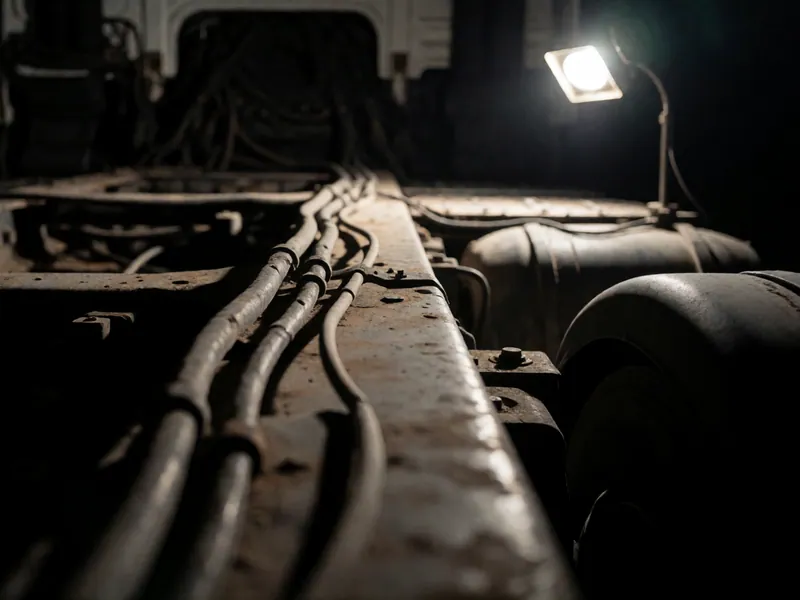
Cable runs following a truck chassis rail at night

The questions this page gets

Do you work on electric and hybrid vehicles?

The twelve-volt side, yes — the battery, the lighting, the body modules, the accessory circuits, all of it ordinary work. We do not go inside the high-voltage traction system: that is several hundred volts and it is a different trade with its own qualification and its own equipment.

Can you turn off a warning light?

We can clear a code once the reason it was set has been found and fixed. Clearing one to make a light go out is deleting the evidence, and the light comes back — usually on the way home.

Will you delete an emissions system or adjust the mileage?

No. Both are federal offences, and neither is a service anybody offers honestly. If a vehicle arrives with something like that already fitted we will say what we have found and we will not work around it.

Can you cut a key or program a new one?

Only with documented proof that the vehicle is yours — title or registration in your name and identification that matches. That is not a formality: the entire value of a security system is that it cannot be got round by somebody plausible with a story.

Do you guarantee the work?

Any repair we made that fails within thirty days is looked at again without another diagnostic charge. That covers what we did. It is not a warranty on the rest of the vehicle, and a workshop that offers one of those is offering something it cannot pay for.

Everything else on this website is inside the line

If it is ours, telephone

The symptom check takes about three minutes and gives you a written summary of which circuits would be tested first and why, with the hours and the published rate against each. It is an indicative scope and not a diagnosis — nobody has seen the vehicle — but it is a better opening than a blank contact form. If you would rather skip it, the telephone works.