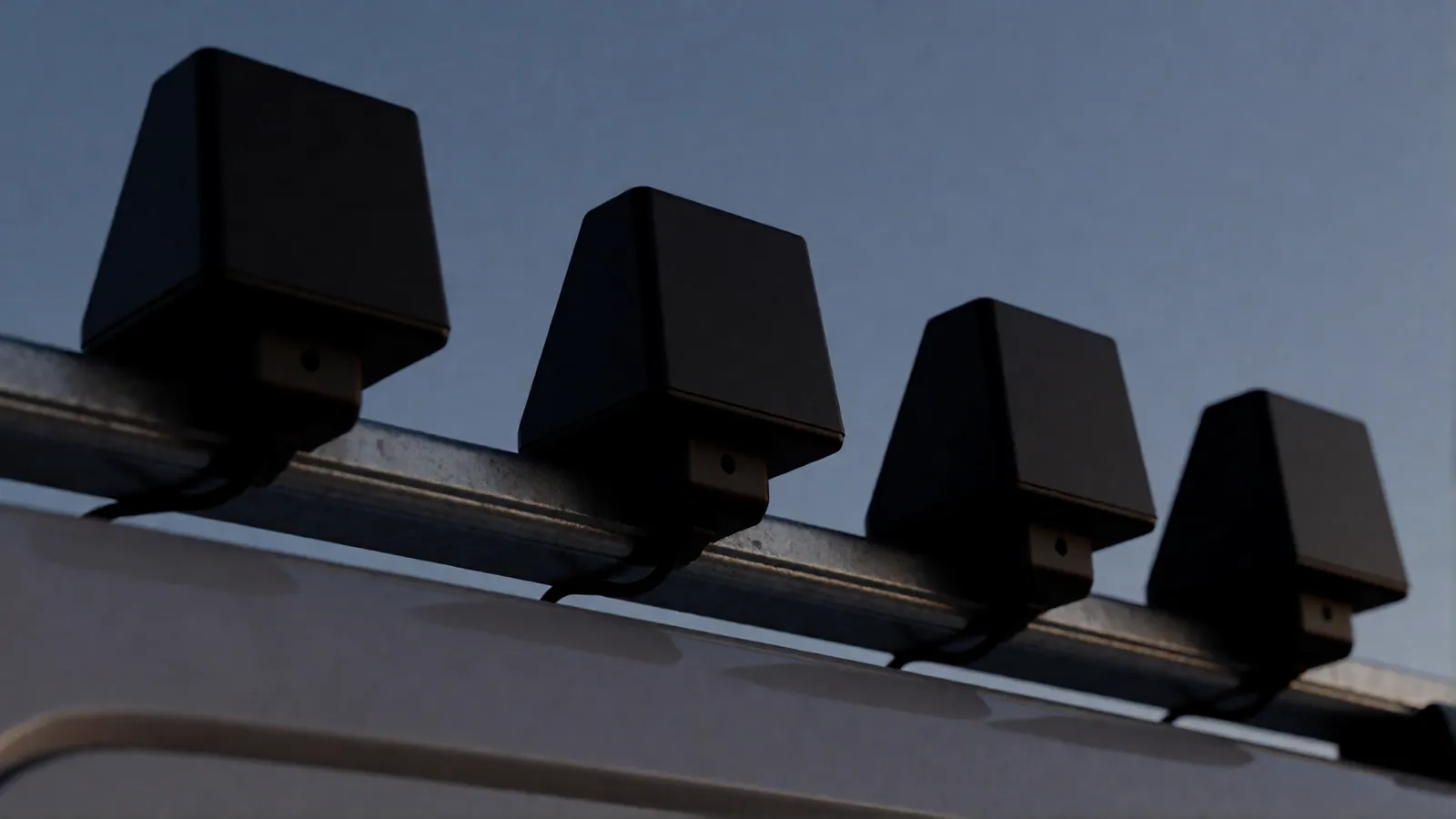
Cameras, work lighting, beacons, trackers, inverters and fridges — fused properly, taken from the right supply, and not spliced into the first wire that had power on it.
five jobs on the rate card
Labour from $145
one to eight hours
“We had a camera fitted and now the dash lights up at random.”
Half of the intermittent faults on this website started life as somebody else's installation. That is not a slight on the equipment — a camera, a tracker and a light bar are all fine products. It is where they were connected.
An accessory taken off a line that carries data rather than power, an unfused feed, a ground screwed to a painted panel, or a device on a permanent live that never lets the vehicle sleep will each produce symptoms that read exactly like a fault in the vehicle itself. The last one is the single most common cause of a flat battery on something that is only used at weekends. So work fitted here is fused at the source rather than somewhere along the run, taken from a supply that is designed to carry it, sized to the load and the length of the run rather than to whatever cable was on the van, and drawn on a sheet that goes to you as well as into the folder. The drawing is not ceremony: the next person to chase a fault on that vehicle may not be us, and on most vehicles that sheet is the only record that the equipment is there at all.
What would actually be measured
In roughly this order, and none of it names a part
What the equipment actually has to draw, added up, before any cable is chosen
Which supply it comes off, and whether that supply is meant to sleep
Fusing at the source, at the rating the cable can carry rather than the rating the box came with
Where the cable runs, what it passes through and how it is protected at every bulkhead
The ground, taken to bare metal rather than to a painted panel or a seat bolt
A drawing of what was fitted, which goes to you as well as into the folder
The jobs
What you can buy, and what the labour costs
Hours are chargeable hours. The figure is the published rate for where the work
happens multiplied by those hours, and there is nothing else in it — parts are separate
and are at cost plus 20 per cent with both numbers on the invoice.
Auxiliary installations. Hours are chargeable hours. The figure is the published rate for where the work happens, multiplied by the hours, and there is nothing else in it — parts are separate and are at cost plus 20 per cent with both numbers on the invoice. Where a job can be done in the workshop or on site, its figure is the workshop one. Done where the vehicle stands rather than here, the same hours are at the on-site hour, $185.
Job
Hours
Where
Labour
Fault-finding on equipment somebody else fitted
one to four hours
workshop
$145 to $580
Reversing camera and parking sensors
two to five hours
workshop
$290 to $725
Work lighting and beacons
two to six hours
workshop or on site
$290 to $870
Telematics, trackers and logging device wiring
one to three hours
workshop or on site
$145 to $435
Inverters, fridges and auxiliary power
three to eight hours
workshop
$435 to $1,160
Fault-finding on equipment somebody else fitted
$145 to $580
A camera, a tracker, a light bar or a radio that has brought a fault with it. Common enough to be its own line on the price list.
one to four hours, turnaround same day
workshop hour, $145, workshop
The first hour: Finding every place the installation touches the vehicle. That is usually more places than the person who fitted it would say.
What you are left holding: A written note of how the equipment was connected, why that produced the fault, and how it has been reconnected.
Reversing camera and parking sensors
$290 to $725
Cameras and sensors on vans, trucks, trailers and machinery, wired so that the picture does not come and go with the indicator.
two to five hours, turnaround same day
workshop hour, $145, workshop
The first hour: Deciding where the supply comes from and where the cable runs, which is the difference between an installation that lasts and one that chafes through in a year.
What you are left holding: The installation, fused at the source, with a drawing of the supplies used.
Work lighting and beacons
$290 to $870
Work lamps, beacons and light bars on vans, tippers, tractors and telehandlers, on relays and fused correctly rather than hung off the nearest live wire.
two to six hours, turnaround same day
workshop hour, $145, here — or the on-site hour, $185, where it stands
The first hour: Loading the circuit that is about to carry it. A light bar drawing fifteen amps off a feed designed for a courtesy lamp is a fire, not a lighting problem.
What you are left holding: The installation, with the relay and fuse positions written down and the switch labelled inside the cab.
Telematics, trackers and logging device wiring
$145 to $435
The wiring and power side of trackers, telematics boxes and electronic logging devices. The harness is ours; the device, its account and its compliance are the supplier's.
one to three hours, turnaround same day
workshop hour, $145, here — or the on-site hour, $185, where it stands
The first hour: Choosing the supply. A tracker on a permanent live that never sleeps is the single most common cause of a flat battery on a vehicle that is only used at weekends.
What you are left holding: A supply that is fused, does not keep the vehicle awake, and is drawn on a sheet for the next person.
Inverters, fridges and auxiliary power
$435 to $1,160
Power for tools, fridges and equipment in a van or a truck, sized to what it has to run and protected so it cannot strand the vehicle.
three to eight hours, turnaround one to two days
workshop hour, $145, workshop
The first hour: Adding up what it actually has to run, which is the step that gets skipped and the reason so many of these are undersized.
What you are left holding: The installation with cable sized to the load and the run, fusing at both ends, and a written drawing of the system.
How that figure is arrived at
Workshop hour× one$145
The same rate, at the long end× four$580
Parts, if any are neededcost + 20%separate
Labour for this jobone to four hours$145 to $580
The workshop hour is $145 and it is on the rates page. That multiplication is the whole of the labour charge: no callout fee on top of it, no shop supplies percentage and no environmental levy. It is the cost of the work — it is not a quotation for a vehicle nobody has seen.
Where this stops
What this is not
We wire equipment; we do not supply, register or support it. A tracker's subscription, a telematics account and an electronic logging device's compliance are all the supplier's, and we will say so before the work starts rather than after somebody has telephoned us about an app.
The yard that kept flattening batteries over a weekend
Haulage, general freight · Nine tractor units, one yard
Three units in nine would not start on a Monday. Batteries had been replaced across the fleet twice in eighteen months and the supplier was being blamed.
What we did: A drain test on two of the affected units and one that was fine, each left overnight so the modules settled. Six hours over three visits.
Every case study on this site is an illustrative composite assembled from several jobs. No customer is named, no vehicle is identifiable, and there is not a single testimonial on this website attributed to a person — a fabricated one would be the one genuinely dishonest thing a workshop's website can do.
Worth reading first
The good reading that hides a bad circuit
A connection can read twelve and a half volts with a meter on it and still be the reason nothing works. Voltage drop testing takes twenty minutes, finds it, and is skipped almost everywhere.
One hour, charged at the rate for where it happens: $145 in the workshop, $185 on site, $125 on the bench for a control unit. That hour is measurement rather than guessing, and at the end of it you get what was measured and what it would cost to put right, in writing. If the fix takes under fifteen minutes it happens inside the hour and there is nothing more to pay.
Do you come out, or does it have to come to you?
Trucks and machinery are almost always seen where they stand. Cars and vans are usually quicker and cheaper here, because the equipment does not have to be carried to them. Bench work on a control unit only happens at Hatfield Lane.
How do you charge for parts?
At what they cost us plus twenty per cent, and the invoice shows both numbers. We take no rebate, commission or bonus from any supplier for fitting one brand rather than another.
Do you guarantee the work?
Any repair we made that fails within thirty days is looked at again without another diagnostic charge. That covers what we did. It is not a warranty on the rest of the vehicle, and a workshop that offers one of those is offering something it cannot pay for.
Auxiliary installations · labour from $145
Describe the symptom, or telephone
The symptom check takes about three minutes and gives you a written summary of which circuits would be tested first and why, with the hours and the published rate against each. It is an indicative scope and not a diagnosis — nobody has seen the vehicle — but it is a better opening than a blank contact form. If you would rather skip it, the telephone works.